Quantization in Depth 2
Get the scale and zero point
Linear quantization maps the floating point range $[r_{min}, r_{max}]$ to the quantized range $[q_{min}, q_{max}]$.
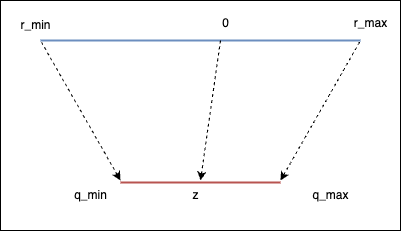
If we look the extreme values, we could get:
$$ \begin{cases} r_{min} = s(q_{min} - zero_ point) \\ r_{max} = s(q_{max} - zero_ point) \end{cases} $$
Substracting the first equation from the second, we could get the scale $s$:
$$ r_{max} - r_{min} = s (q_{max} - q_{min}) \\ $$ $$ s = (r_{max} - r_{min})/(q_{max} - q_{min}) $$
For the zero point $z$, we need to round the value since it is an integer:
$$ z = round(q_{min} - \frac{r_{min}}{s}) $$
Why make $z$ an integer?
$$ z = int(round(q_{min} - \frac{r_{min}}{s})) $$
Example
to be continued…
Zero point out of range
- $z$ < $q_{min}$: set $z$ = $q_{min}$
- $z$ > $q_{max}$: set $z$ = $q_{max}$
Linear quantization scale and zero point pytorch
import torch

from helper import linear_q_with_scale_and_zero_point, linear_dequantization

test_tensor = torch.tensor(
    [[191.6, -13.5, 728.6],
     [92.14, 295.5, -184],
     [0, 684.6, 245.5]]
)
q_min = torch.iinfo(torch.int8).min
q_max = torch.iinfo(torch.int8).maxq_min-128q_max127r_min = test_tensor.min().item()
r_min-184.0r_max = test_tensor.max().item()
r_max728.5999755859375scale = (r_max - r_min) / (q_max - q_min)
scale3.578823433670343zero_point = q_min - (r_min / scale)
zero_point-76.58645490333825zero_point = int(round(q_min - (r_min / scale)))-77def get_q_scale_and_zero_point(tensor, dtype=torch.int8):
q_min, q_max = torch.iinfo(dtype).min, torch.iinfo(dtype).max
r_min, r_max = tensor.min().item(), tensor.max().item()
scale = (r_max - r_min) / (q_max - q_min)
zero_point = q_min - (r_min / scale)
if zero_point < q_min:
zero_point = q_min
elif zero_point > q_max:
zero_point = q_max
else:
zero_point = int(round(zero_point))
return scale, zero_point
new_scale, new_zero_point = get_q_scale_and_zero_point(test_tensor)3.578823433670343new_zero_point-77quantized_tensor = linear_q_with_scale_and_zero_point(test_tensor, new_scale, new_zero_point)
dequantized_tensor = linear_dequantization(quantized_tensor, new_scale, new_zero_point)
(dequantized_tensor - test_tensor).square().mean()tensor(1.5730)from helper import plot_quantization_errors
plot_quantization_errors(test_tensor, quantized_tensor, dequantized_tensor)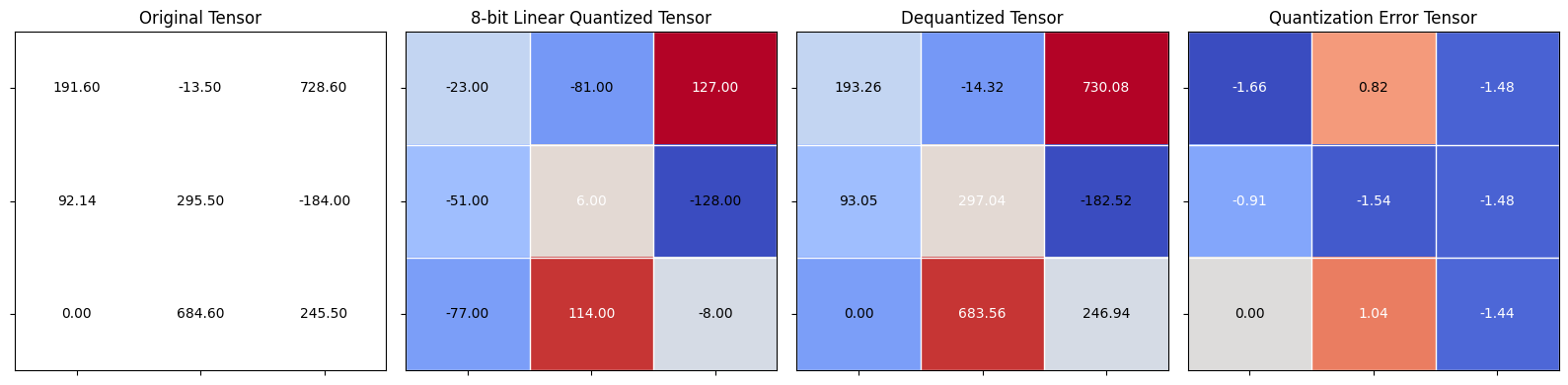
(dequantized_tensor - test_tensor).square().mean()tensor(1.5730)def linear_quantization(tensor, dtype=torch.int8):
scale, zero_point = get_q_scale_and_zero_point(tensor, dtype=dtype)
quantized_tensor = linear_q_with_scale_and_zero_point(tensor, scale, zero_point, dtype=dtype)
return quantized_tensor, scale, zero_point
r_tensor = torch.randn((4, 4))
r_tensortensor([[ 1.6714, -1.3308, 0.4337, 1.0956],
[-1.8622, 2.4572, 1.0099, -1.0139],
[ 0.2309, 1.3375, -0.8019, -0.6140],
[-0.4675, -1.4661, -1.0904, 0.4055]])quantized_tensor, scale, zero_point = linear_quantization(r_tensor)
quantized_tensortensor([[ 81, -97, 8, 47],
[-128, 127, 42, -78],
[ -4, 61, -65, -54],
[ -46, -105, -82, 6]], dtype=torch.int8)scale0.01693895798103482zero_point-18dequantized_tensor = linear_dequantization(quantized_tensor, scale, zero_point)
plot_quantization_errors(r_tensor, quantized_tensor, dequantized_tensor)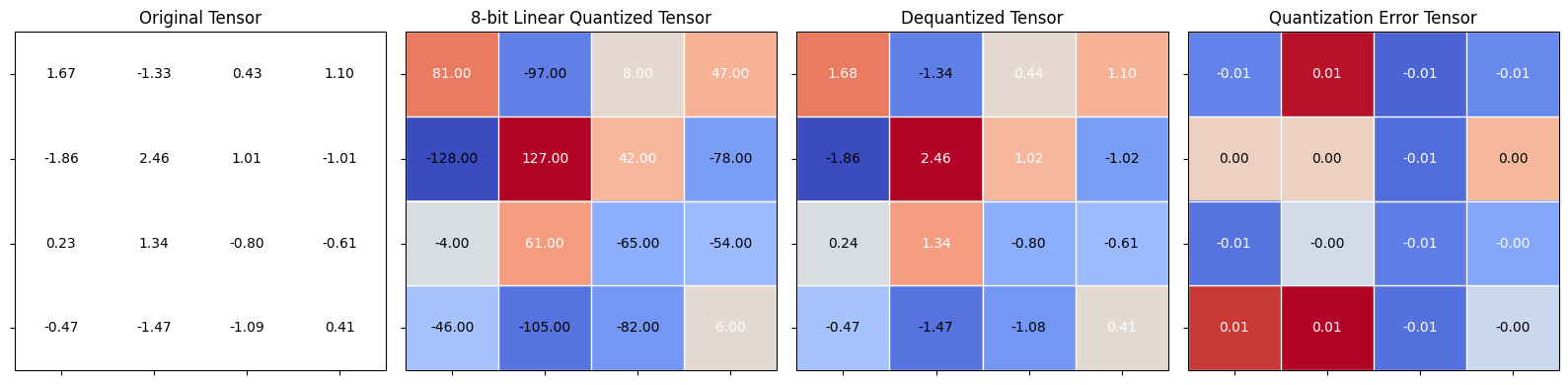
(dequantized_tensor - r_tensor).square().mean()tensor(2.7701e-05)